
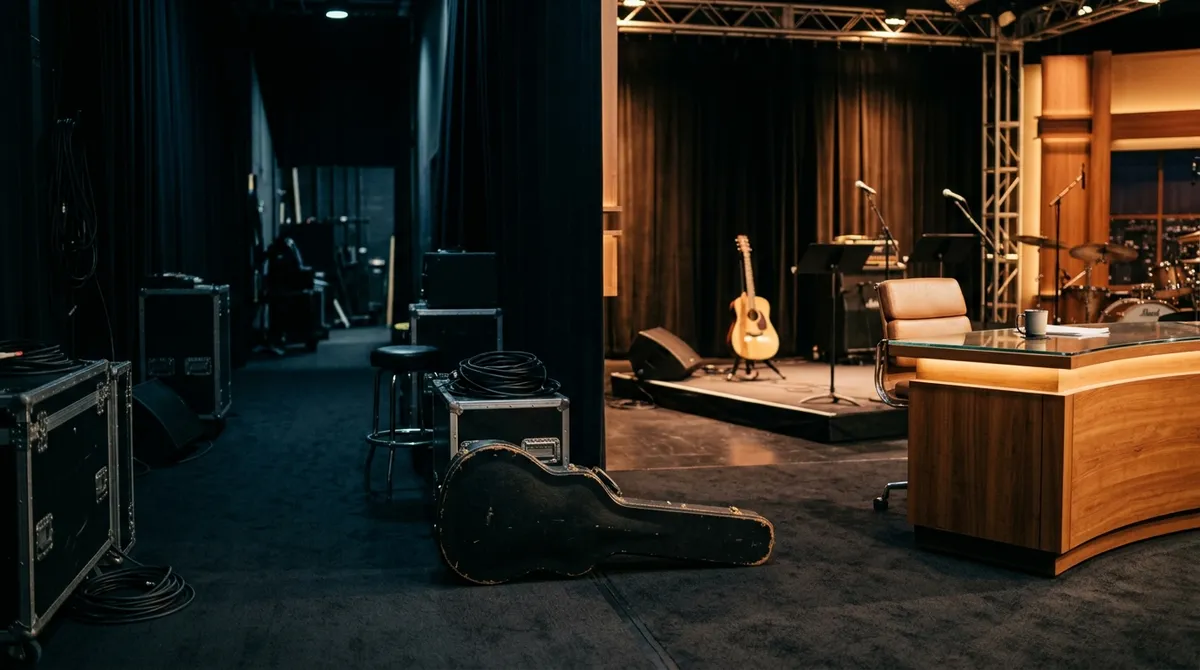
Picture the opening of The Late Show with Stephen Colbert, and then picture Elvis Costello behind the desk-side bandstand instead of the one we got. According to a Vulture piece, that nearly happened: Costello pitched himself directly to Colbert as bandleader before the show's 2015 premiere, and the talks got serious before the whole thing fell apart.
The reasons, per Vulture, were not creative. They were logistical, and a little bit cultural. Moving his band, the Imposters, to New York was the main obstacle, and Costello also had concerns about clashing with CBS corporate culture.
The Pitch
This wasn't a case of a manager floating a name. Per Vulture, Costello went straight to Colbert and asked. That's a notable move for an artist whose résumé is basically a long list of left turns, and it fits the idea that he's never been shy about reinventing himself.
Costello's reasoning, as Vulture's description of the interview has it, was shaped by what other bands were doing in the format. "I saw what the Roots had achieved across town," he recalls. He also notes that "lots of really great people have done that gig."
He's right on the pop-culture history. The Roots on Late Night (the "across town" he's talking about) turned a house band into a genuine cultural institution, and Jon Batiste later did the same on Colbert's own Late Show. Branford Marsalis is another name in that lineage. The house-band job, once a background-music gig, has become a place where serious musicians do some of their most visible work.
Why a Rock Legend Would Want the Gig
Here's my read: the appeal is not hard to see. A late-night band is a steady, high-profile room, with a different guest every night and a live audience, and you sleep in your own bed. For a touring musician, that last part is not nothing. Vulture frames the story as part of a broader pattern of established artists weighing a stable institutional role over life on the road, and it's hard not to see why a veteran might find that tempting.
It's also a gig where musical range is the job. You back up whoever walks in. For an artist who has moved between genres and collaborators across a long career, it's a bit like being handed the keys to the whole record store.
The Part Where Reality Shows Up
Then came the unglamorous stuff. Costello's band, the Imposters, would have needed to relocate to New York. Uprooting a touring band is not like transferring offices; it means asking multiple people to rearrange their lives, and, as Vulture's summary of the story implies, family logistics matter too. A dream job that requires everyone to move cities is a dream with a very large moving van attached.
Then there's the corporate side. Costello was, per Vulture, self-aware about not being a natural fit for CBS's culture. He even predicted he'd be fired within weeks. That line is the most Costello thing in the whole story: enthusiastic enough to pitch himself, honest enough to forecast his own dismissal.
I can't speak to how that would have gone, and nobody can. But the picture of one of rock's most famously prickly and brilliant songwriters navigating network notes is, I'll admit, a very entertaining hypothetical.
The Late Show That Never Was
The fun of a near-miss is the alternate timeline. Late-night band dynamics have become a real part of how these shows land, from the Roots' reputation to Batiste's tenure, so the choice of bandleader shapes a show's identity. A Costello-led Late Show would have sounded different, and quite possibly felt different, in ways we can only guess at.
What we do know, from Vulture's reporting, is that this wasn't idle chatter. The talks were serious. It simply collided with the unromantic facts of moving a band and fitting a corporate mold.
There's something oddly reassuring about that. Even for a rock legend who can ask a talk show host for a job directly, the thing that kills a dream gig can be a relocation plan. Not creative differences, not a feud, just a U-Haul.
And maybe that's the sharpest takeaway: the most interesting what-ifs in entertainment rarely die dramatically. They die in a spreadsheet of logistics, with everyone still thinking it would've been great.